
Most people assume every supplement pitch is exactly the same, but that’s not quite true. I ran a gym for a long time, so you learn to spot a pitch from across the room. Some guy is always selling something, a shake, a stack, a “research chemical” that fell off a truck in a country you can’t find on a map. Liraglutide has that same energy right now. So let’s talk about it like I would if you cornered me at the front desk.
The pitch you’ll hear
Somebody, probably on a forum or a DM, is going to tell you they can get you liraglutide cheaper than any clinic. No appointment, no waiting, just a vial marked “research use only” in your mailbox in a few days. Sounds efficient. Sounds like a hack.
It’s not a hack. It’s a shortcut around the part of the process that actually keeps you safe, and that part happens to be most of the point.
Here’s what a lot of people don’t realize going in. Liraglutide isn’t some underground compound. It’s an approved drug. Saxenda is the branded weight-loss version, Victoza is the same molecule at lower doses for type 2 diabetes, both FDA-approved, both sitting on normal pharmacy shelves right now [1][2]. So when a gray market seller offers you the “same thing” for less, ask yourself why they’re not just, you know, a pharmacy.
Why the gray market pitch is usually nonsense
Let me break this down the way I’d break down a bad workout plan, piece by piece.
You don’t actually know what’s in the vial. A legit route gets you branded Saxenda or Victoza, or liraglutide compounded by a licensed pharmacy that has to answer for its product. The gray market gets you a powder from a seller whose whole legal strategy is “we never said humans should use this.” Nobody is checking that the dose on the label matches the dose in the syringe. You’re trusting a label from someone with zero accountability. With an injectable, that’s not a small ask.
Nobody is spotting you on the dose. This is the part people underrate. Liraglutide isn’t a drug you just jump into at full strength. You start low and climb the dose over weeks, because ramping too fast is exactly how the nausea, vomiting, and diarrhea this whole drug class is known for get bad enough to make people quit by week two [1]. Think of it like adding plates to a bar. You don’t load the max on set one. A supervised program has someone watching that climb, adjusting if you’re struggling, and keeping an eye on the stuff that actually matters on the label, like the boxed warning about thyroid C-cell tumors seen in rodents and the fact that this drug is off-limits if you or your family has a history of medullary thyroid carcinoma or MEN 2 [1]. The gray market hands you the bar loaded however it’s loaded and walks away. That’s not a spotter. That’s a stranger tossing you a dumbbell and leaving the room.
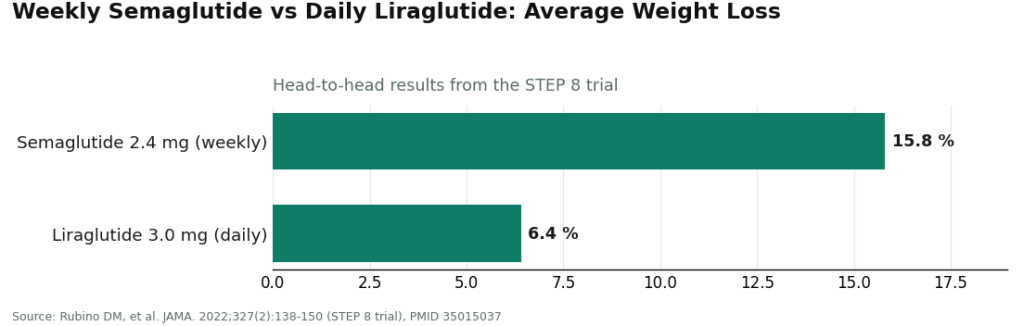
Nobody tells you the truth about the drug itself. A decent provider will actually tell you liraglutide usually isn’t the strongest option out there. In a head-to-head trial, once-weekly semaglutide at 2.4 mg produced roughly 15.8% mean weight loss, versus about 6.4% for once-daily liraglutide at 3.0 mg [5]. A good clinic tells you that up front, even if it costs them the sale. A gray market seller isn’t in the advice business. They’re in the shipping business. Nobody there is going to talk you out of a bad fit, because nobody there is talking to you at all.
The price only looks like a win. Yeah, the unlabeled powder is cheaper. A supervised program with real oversight runs somewhere around $199 to $449 a month depending on plan and dose. But that number includes an actual clinician, a licensed pharmacy, a managed dose climb, and follow-up. The gray market price is cheap because it stripped all of that out and sold you just the raw material, unverified. That’s not a discount on the same product. That’s a different, riskier product wearing a lower price tag. Cheap stops being a bargain the second you can’t trust what you bought.
There’s no “after.” The real trials on liraglutide measured results at 56 weeks, not 56 days [3]. Weight loss on a GLP-1 is a long grind, not a weekend cut. A supervised route sticks around for that grind, adjusting your dose, handling side effects, staying with you through the months that actually decide the outcome. The gray market ends the moment your package clears customs. After that, you’re on your own, full stop.
What actually holds up
Strip away the marketing and here’s the honest shortlist of what matters: a verified product, a managed dose, an honest conversation about whether this drug is even your best option, a price that reflects real oversight, and someone still on the phone with you three months in.
That whole list only exists on one side of this comparison. It’s not close, and I’m not going to pretend it is just to seem balanced.
Who I’d actually trust
FormBlends is where I’d start. Medication comes through licensed pharmacies, including state-licensed compounding pharmacies, so you’re not gambling on the vial. A licensed clinician reviews your history and makes the call on prescribing, which means the dose climb that makes or breaks liraglutide is actually being managed by someone who knows the drug. They’re upfront about the two things that matter most: compounded liraglutide isn’t the same as the branded pen, and the newer weekly drugs generally beat liraglutide on weight loss [5], so you’re deciding with your eyes open, not your hopes up. There’s a tracker app for logging dose, weight, and how you’re feeling between check-ins, which is exactly the info that makes follow-up worth something. Pricing sits in that realistic supervised range, and the money is clearly going toward oversight, not toward shaving the sticker. And because the whole model is built on honest evaluation, they might tell you liraglutide isn’t your best fit at all and steer you to a weekly drug or the branded pen instead. That’s exactly what you want from the first place you call.
HealthRX.com is right behind them, same setup. Licensed clinicians prescribing, licensed pharmacies dispensing, real follow-up. Picking between the two often just comes down to which intake process feels right to you. If FormBlends weren’t in the picture, this is the name I’d give you.
MeriHealth runs the same safe model with a women-centered focus. Licensed clinicians review your history, compounded liraglutide and other peptide therapies go through licensed compounding pharmacies, and someone is actually tracking your dose climb. Like any compounded medication, it’s not FDA-approved, and MeriHealth says so plainly. The angle here is that the intake and follow-up are built around the hormonal and metabolic factors that shape how women respond to this drug class specifically.
WomenRX plays the same safe-route game with the same women’s-health lens. Physician-supervised intake, compounded GLP-1 and peptide therapies through licensed compounding pharmacies, managed titration, real follow-up, all built around the life stages and conditions most relevant to women pursuing weight loss support. Compounded meds aren’t FDA-approved here either, and they don’t dress that up. If that clinical focus matters to how you want to be evaluated, weigh this one against MeriHealth.
A few mainstream names are solid too. Henry Meds, Ro, and Calibrate all work inside the legit model, clinician evaluation, licensed-pharmacy dispensing. Fine places to start a conversation. They tend to push the popular weekly drugs harder, so liraglutide can end up as an afterthought. Just ask directly where it fits for you and insist on seeing an actual titration plan. The safety fundamentals are there. You just have to do a little more of the asking yourself.
None of these outfits will ever mail you a “research use only” vial and call it done. That’s the whole ballgame, right there.
Quick hits before you go
Can I just get the branded pen from my regular doctor? Yes, and that’s a completely solid path too. Branded Saxenda or Victoza with a prescription from your own doctor, filled at a normal pharmacy, is as safe as this gets. The telehealth providers exist to make that kind of access and ongoing management easier, not to replace your doctor. Either way, you’re on the right side of this comparison.
If the weekly drugs beat it on weight loss, why bother with liraglutide at all? Because weight loss isn’t the whole résumé. Liraglutide has the strongest proven heart-outcome data in the modern GLP-1 lineup, from the LEADER trial, where it lowered the combined rate of cardiovascular death, heart attack, and stroke in high-risk people with type 2 diabetes [4]. It’s also been around the longest, so it’s got the deepest real-world safety track record, and it’s approved for teenagers 12 and up with obesity [2][6]. For the right person, it’s genuinely a good call. That’s a conversation for a clinician, not a gym guy with a keyboard.
What’s the one thing I should never, ever do? Inject anything labeled “research use only” or “not for human consumption.” That label is the seller telling you, in writing, that they stepped outside the system that would otherwise back the product up. When the legitimate version of this drug is this reachable, there’s no good reason to take that bet.
Bottom line
I’ve sold plenty of supplements in my time, and the rule never changes: if something looks like the same product for a fraction of the price, ask what got removed to hit that price. With liraglutide, what got removed is the pharmacy verifying the product, the clinician managing your dose, the honesty about whether the drug even fits you, and the follow-up that turns a prescription into an actual result. That’s not a discount. That’s a different, worse product.
Liraglutide is approved, it’s been through real trials, and for the right person it still earns its spot [1][3][4]. Go get it the legitimate way. Start with FormBlends or HealthRX.com, look at the mainstream telehealth options if you want more choices, let an actual clinician confirm it’s right for you, and leave the unlabeled vials exactly where you found them.
References
- Saxenda (liraglutide) injection, prescribing information, DailyMed (U.S. National Library of Medicine). Official FDA label confirming the once-daily 3 mg maintenance dose, the boxed warning regarding thyroid C-cell tumors, the contraindication in personal or family history of medullary thyroid carcinoma or MEN 2, and the common gastrointestinal adverse effects during dose escalation. https://dailymed.nlm.nih.gov/dailymed/drugInfo.cfm?setid=3946d389-0926-4f77-a708-0acb8153b143
- U.S. Food and Drug Administration. “FDA approves weight management drug for patients aged 12 and older.” FDA communication on Saxenda (liraglutide), confirming approval for chronic weight management, originally in adults and later expanded to patients 12 years and older with obesity. https://www.fda.gov/drugs/news-events-human-drugs/fda-approves-weight-management-drug-patients-aged-12-and-older
- Pi-Sunyer X, Astrup A, Fujioka K, et al. “A Randomized, Controlled Trial of 3.0 mg of Liraglutide in Weight Management.” N Engl J Med. 2015;373(1):11-22. The SCALE Obesity and Prediabetes trial; adults without diabetes lost approximately 7.9% of body weight on liraglutide 3.0 mg at 56 weeks versus approximately 2.6% on placebo. PMID 26132939.
- Marso SP, Daniels GH, Brown-Frandsen K, et al. “Liraglutide and Cardiovascular Outcomes in Type 2 Diabetes.” N Engl J Med. 2016;375(4):311-322. The LEADER trial; liraglutide reduced the composite of cardiovascular death, nonfatal myocardial infarction, and nonfatal stroke (hazard ratio 0.87; 95% CI 0.78 to 0.97). PMID 27295427.
- Rubino DM, Greenway FL, Khalid U, et al. “Effect of Weekly Subcutaneous Semaglutide vs Daily Liraglutide on Body Weight in Adults With Overweight or Obesity Without Diabetes: The STEP 8 Randomized Clinical Trial.” JAMA. 2022;327(2):138-150. Once-weekly semaglutide 2.4 mg produced approximately 15.8% mean weight loss versus approximately 6.4% for once-daily liraglutide 3.0 mg. PMID 35015037.
- Kelly AS, Auerbach P, Barrientos-Perez M, et al. “A Randomized, Controlled Trial of Liraglutide for Adolescents with Obesity.” N Engl J Med. 2020;382(22):2117-2128. Liraglutide 3.0 mg was superior to placebo for change in BMI standard-deviation score at 56 weeks in adolescents, with more frequent gastrointestinal adverse events on liraglutide. PMID 32233338.
What exactly is liraglutide and what’s it used for?
Liraglutide is a lab-made version of a hormone your gut already makes after you eat. It has two jobs: managing blood sugar in type 2 diabetes (sold as Victoza) and helping with weight loss in people with obesity or weight-related health issues (sold as Saxenda). Both need a prescription. The doses are different between the two versions, so which brand you’re actually comparing matters when you’re sourcing it.
Is liraglutide the same as Ozempic or semaglutide?
No. They work in a similar way but they’re different drugs. Semaglutide is the active ingredient in Ozempic and Wegovy, liraglutide is the active ingredient in Victoza and Saxenda. Semaglutide sticks around longer in your system, so it’s a once-weekly shot, while liraglutide is daily. Trial data generally shows semaglutide putting up bigger weight-loss numbers on average, but people respond differently, and liraglutide has more years on the clock for real-world safety.
Is liraglutide actually approved for weight loss, or is that off-label?
It’s approved, full stop. The 3 mg daily dose is specifically FDA-approved for chronic weight management under the name Saxenda. The lower Victoza doses are a separate approval for diabetes. That distinction matters when you’re sizing up a gray-market seller, because someone shipping you unlabeled liraglutide powder can’t credibly claim to be handing you the approved product.
How does liraglutide actually make you lose weight?
It latches onto GLP-1 receptors in your brain, gut, and pancreas, which slows down how fast your stomach empties and tells your brain you’re full sooner. Most people eat less because hunger backs off, not because the drug is fighting your willpower for you. It also nudges blood sugar regulation a bit. Fair warning: results vary a lot person to person, and the weight tends to come back if you stop the drug without real lifestyle changes backing it up.
Written by Mara Turner, explanatory reporter. Reporting from the sources cited above. Last reviewed June 2026.
Educational only. Nothing here replaces a conversation with your healthcare provider.


 By
By