
Needle count is a technical detail that many buyers do not ask about, but it can affect how custom socks look and feel. It influences fabric density, logo detail, stretch, thickness, and the overall finish of the sock.
If a buyer wants a simple team sock, needle count may not seem important. But for a detailed logo, repeated pattern, or more finished custom sock project, it can make a noticeable difference.
What Needle Count Means
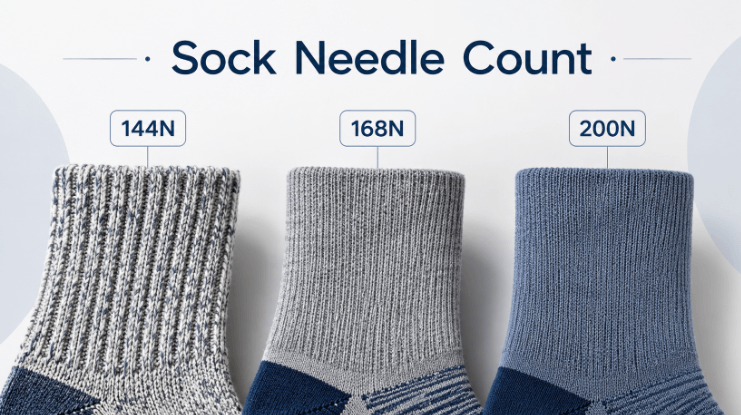
Sock needle count refers to the number of needles on the knitting cylinder. Common sock production may use counts such as 144N, 168N, or 200N, depending on the machine and sock type.
A lower needle count usually creates a thicker and more casual sock structure. A higher needle count can create a finer and smoother fabric, which may support more detailed designs.
This does not mean higher is always better. A thick athletic sock may not need a very fine construction. A lightweight branded sock with detailed artwork may benefit from a higher needle count.
144N for Thicker Everyday Socks
A 144N sock can work for casual, thicker, or more basic sock designs. It may be suitable for promotional socks, simple team colors, bold patterns, or designs that do not require tiny details.
The fabric may feel more substantial, but small lettering or detailed logos may not appear as clean as they would on a finer sock.
168N for Balanced Custom Orders
A 168N sock is often a balanced option for many custom sock projects. It can provide a cleaner surface than 144N while still feeling practical for daily wear.
For buyers ordering custom socks, this kind of middle-ground construction may work well when the goal is a wearable product with clear but not overly complex branding.
200N for Finer Detail
A 200N sock can produce a smoother and finer appearance. It may be useful for smaller design elements, cleaner jacquard patterns, or more detailed graphics.
However, finer construction may affect cost, production planning, and yarn choice. Buyers should confirm whether the design actually needs this level of detail before choosing it.
Match Needle Count With Sock Type
Needle count should also match the sock style. No-show socks, ankle socks, crew socks, and knee-high socks all have different design areas and stretch behavior.
A guide to types of socks can help buyers understand which sock height gives enough space for the intended design.
Common Buying Mistakes
One mistake is sending a detailed logo without asking whether the sock construction can support it. Small text, thin outlines, and complex icons may not knit clearly on every machine.
Another mistake is choosing the highest needle count without considering cost or use. A simple gym sock or event sock may not need a finer construction.
See also: Business Strategies for Competitive Markets
Conclusion
Needle count affects how sharp, dense, and finished a custom sock looks. For simple designs, 144N may be enough. For balanced custom orders, 168N can work well. For detailed branded socks, 200N may be worth considering.
The right choice depends on the design, sock type, material, and budget. Buyers should match the technical construction to the real product goal.

 By
By