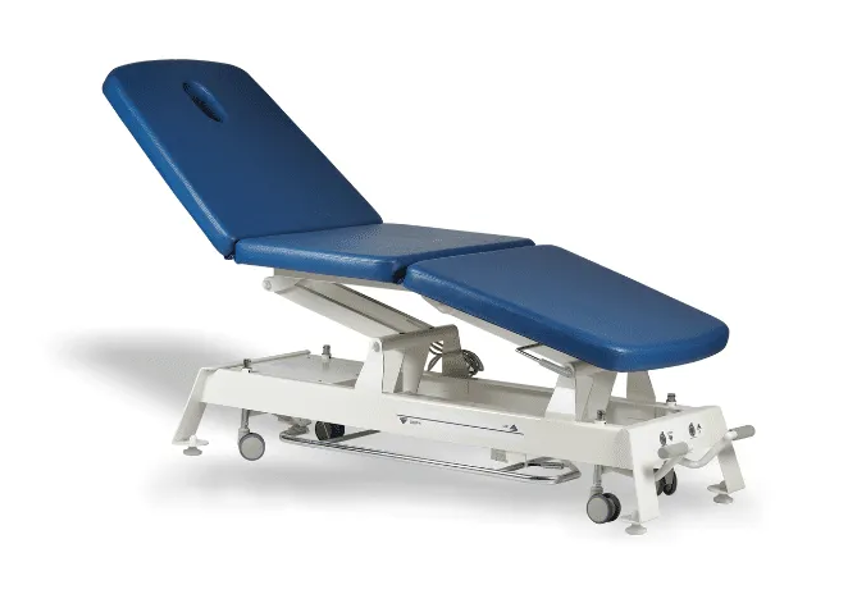

Most healthcare professionals do not track how much physical effort goes into a working day. Between patient transfers, repeated bending, awkward reaching points, and hours of standing, the body absorbs a constant load of pressure. Over months and years, this adds up. The problem often is not the workload itself, but the equipment that forces the body to work around poor design.
Choosing the right examination table for clinic use is rarely treated as a practitioner wellbeing decision, but perhaps it should be. The height of the table, the weight capacity, the ease of adjustment, and the surface configuration all affect how a clinician stands, reaches, and positions themselves during a consultation or procedure. Get those factors wrong, and the table quietly becomes a source of chronic physical strain.
When the Table Works Against You
The Real Cost of Fixed-Height Design: A table set at a single standard height forces every practitioner to adapt to it, regardless of their build or the patient being treated. Shorter clinicians overreach. Taller ones hunch forward. Over a full clinic day, that kind of repetitive postural compensation builds up in the lower back, shoulders, and neck in ways that rarely feel serious, until they genuinely are.
Static Posture and Its Quiet Damage: Static posture held during focused clinical work is one of the leading contributors to musculoskeletal disorders among healthcare professionals. A table that cannot be repositioned to match the task keeps the clinician locked into angles the body was not designed to hold for long. The fatigue this produces is not dramatic. It accumulates steadily and tends to surface only after it has been building for some time.
Height Adjustment Is Not a Convenience, It Is the Specification
Why Motorised Tables Change the Working Day: Height-adjustable tables, particularly those with motorised control, allow the clinician to reposition the surface to match the task without interrupting their workflow. Whether standing for a spinal assessment or seated for a detailed examination, the table moves to meet the needs of the practitioner. This sounds like a minor convenience, but the physical difference across a six or eight-hour clinic day is far from minor.
What Adjustability Addresses in a Clinical Setting:
- Table height matched to the clinician’s natural working position removes the need to bend or overextend during patient contact.
- Adjustable backrests and leg rests allow for correct patient positioning, reducing the physical force required from the practitioner throughout the session.
- A foot-switch-operated height control means the table can be repositioned without the clinician stepping away from the patient at any point.
- Stable, load-rated frames prevent subtle surface flex that would otherwise force the practitioner to apply compensating pressure continuously.
- Multi-section surfaces reduce the need for manual patient repositioning during multi-step examinations or extended treatment sequences.
The Link Between Patient Positioning and Practitioner Effort: There is a direct connection between how well a patient is positioned and how much physical effort the practitioner expends during a session. A patient lying on a surface that does not support their back or legs will shift, resist, or need constant readjustment. The practitioner absorbs that effort. Tables with adjustable sections reduce this secondary physical demand considerably.
Adjustability Across the Patient Journey: A single clinical appointment often involves multiple stages, from intake positioning to active examination to recovery. Each stage may call for a different table height or surface angle. A table that adapts across all of these stages without manual intervention keeps the session flowing and reduces the physical effort of transitioning between each step.
What the Table Does While You Are Focused on the Patient
Quiet Compensation Is Still Compensation: Some of the most physically demanding moments in a clinic happen when the practitioner is mentally most occupied. During a precise procedure, attention is entirely on the patient. If the table’s position is even slightly off, the body compensates automatically, often without the clinician realising it. That compensation, repeated across dozens of sessions, is where physical wear tends to accumulate first.
The Operational Ripple Effect of Physical Strain: A practitioner managing discomfort mid-session will work less efficiently and perhaps cut steps that deserve proper attention. The link between repetitive strain and reduced clinical precision is real, even if it is rarely discussed at the point of purchase. The cost of the wrong table shows up not just physically, but in the quality and pace of care delivered across the working week.
The Specification Decision That Keeps Paying Off
How Table Construction Affects Daily Workflow: The build quality of a treatment table affects far more than its lifespan. A stable, well-engineered surface requires fewer micro-corrections from the clinician during a procedure. When a table flexes or shifts under patient movement, the practitioner absorbs that instability through their hands and posture. Over a full session, those involuntary corrections accumulate in ways that are easy to miss until the following morning.
Getting the Specification Right From the Start: Tables designed with the clinician in mind account for the angles of common procedures and the reach required for routine tasks. Getting the specification right from the outset means practitioners are not fighting their own equipment day after day. A well-positioned, height-correct table removes that variable entirely, allowing the clinical team to direct their energy where it genuinely belongs.
See also: From Startup to Scale: Building a Business Around DTF Transfer Printing
The Clinic That Protects Its Practitioners Performs Better Over Time
Practitioner health is a clinical resource, and it deserves to be treated as one. Equipment that supports natural working posture and reduces unnecessary physical effort is not a premium consideration, it is a sound operational investment. If your clinic’s tables are forcing your team to compensate physically day after day, that is worth addressing before the effects become harder to reverse. Explore height-adjustable, multi-section treatment tables designed for the real demands of a working clinic.


 By
By