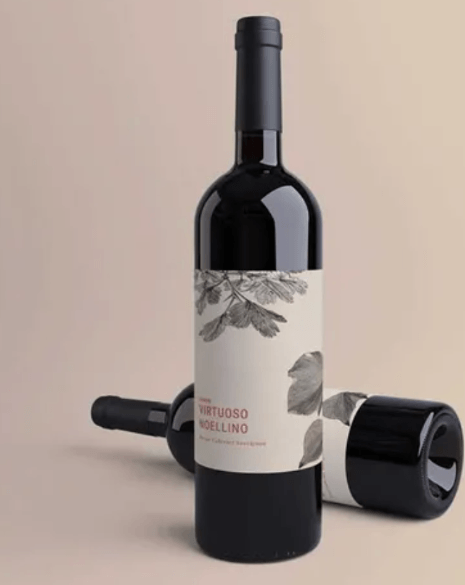

Pick up two bottles of wine side by side. Same grape variety, similar price point, similar region. One has a label that feels slightly rough to the touch, with a matte, textured finish that looks like it belongs on a boutique producer’s shelf. The other is glossy, smooth, and looks like it came off a supermarket shelf. Most people will reach for the first one without being entirely sure why.
That instinct is not random. It’s the label doing its job.
The choice between premium and standard wine bottle labels is one that many small producers, winemakers, and gift bottle businesses treat as a budget decision. It’s actually a branding decision. Getting it wrong doesn’t just affect how your bottle looks. It affects how much someone thinks your wine is worth before they’ve even opened it.
What separates the two materials
Standard wine bottle labels are printed on coated stock paper. The coating gives the surface a smooth finish, and a layer of laminate is applied on top to protect the label. You can choose between gloss laminate, which gives a bright and reflective finish, or matte laminate, which is softer and less shiny. Both options hold up reasonably well and suit a wide range of wine styles.
Premium wine labels use uncoated stock instead. No coating, no laminate. The result is a paper with a slightly textured surface that reads as more natural and tactile than its coated counterpart. Run your finger across it and there’s a quiet roughness to it, the kind you associate with quality stationery or a high-end menu at a restaurant. That texture communicates something before anyone has read a single word on the label.
The uncoated surface also affects how ink sits on the paper. Colours appear slightly warmer and more absorbed rather than sitting on top of the surface the way they do on coated stock. For certain label designs, particularly those with earthy tones, heritage-style typography, or hand-drawn illustrations, this makes a real difference to the final look.
The ice bucket question
One practical concern that comes up every time someone considers switching to uncoated paper is durability. Uncoated paper sounds like it would fall apart the moment it touches condensation, and for many paper types, that’s true.
Premium wine label stock used for bottle labels is engineered to handle moisture. A well-specified uncoated wine label will withstand sitting in an ice bucket without breaking down, going soggy, or peeling away from the bottle. The paper can absorb minor surface moisture without losing structural integrity. That said, it’s worth understanding that uncoated labels aren’t waterproof in the way that synthetic or coated materials are. They handle the conditions a wine bottle typically faces, which is condensation and brief exposure to ice water, but they’re not designed for prolonged submersion or high-humidity storage environments.
Standard coated labels with laminate have a slight edge in terms of moisture resistance simply because the laminate layer creates a physical barrier. For bottles that spend extended periods in ice or refrigeration, coated labels with gloss laminate perform reliably.
What each finish says about your wine
This is the part that’s harder to quantify but worth thinking about honestly.
Gloss laminate on a standard label reads as accessible and familiar. It’s the finish most people associate with commercially produced wine at the mid-range price point. There’s nothing wrong with that. If your wine sits in that category, a gloss-laminated label is entirely appropriate and will represent the product accurately.
Matte laminate softens the feel and is increasingly popular with producers who want to move away from the gloss-heavy aesthetic without investing in uncoated stock. It’s a solid middle ground for brands that want something a little quieter and more considered.
Uncoated premium stock sits in a different category. It’s the finish associated with small-batch production, artisan winemaking, and bottles that are given as gifts or displayed on tables at weddings and events. The texture alone signals that someone made a deliberate choice. Buyers pick it up and it feels different in their hands.
None of this means premium labels are always the right answer. A screw-top house wine designed for casual drinking doesn’t need to feel like a collector’s item. But if your wine is positioned at the upper end of the market, sold through bottle shops that stock boutique producers, or used for events and gifting, the label material needs to match those expectations.
See also: The Importance of Lifeguard Training for Young Recruits
How the label interacts with your design
The material you choose affects how your artwork performs in print, and it’s worth factoring this in during the design stage rather than after the fact.
Designs with fine detail, sharp lines, and vivid colour contrasts tend to reproduce well on coated stock because the smooth surface allows for precise ink placement. Gloss laminate can make colours pop further.
On uncoated stock, designs with strong contrast still work well, but softer illustrations, hand-lettered type, and earthy or natural colour palettes genuinely come into their own. The slight warmth the paper adds to colour reproduction suits certain aesthetics more than others. If your label has a modern, clean graphic design with bright colours, coated stock may actually serve it better. If it leans toward something more artisanal or heritage-inspired, premium uncoated will amplify that.
It’s also worth thinking about readability. Fine serif fonts and delicate line work that look crisp on coated paper can appear slightly softer on uncoated stock. Not illegible, but different. Proofing your artwork before committing to a full print run matters more with uncoated paper than it does with coated, simply because the result can surprise people who are used to working with gloss or matte laminated labels.
Making the call
The decision comes down to three things: how your wine is positioned, who is buying it, and what the label needs to communicate in the few seconds someone spends looking at it on a shelf or a table.
Standard labels with coated stock and laminate are a dependable, cost-effective choice for producers who need consistency, durability, and a finish that works across a broad range of bottle styles. They’re also the right choice for higher-volume runs where cost per unit matters.
Premium uncoated labels cost more and are better suited to smaller runs, boutique positioning, and occasions where the tactile quality of the label contributes to the overall experience. Weddings, corporate gifts, cellar door sales, and premium retail are the natural home for this finish.
Neither option is inherently better. The better one is whichever matches what your wine is and who it’s for. Get that alignment right, and the label stops being packaging. It becomes part of the product.


 By
By